Guide · The collections
Moroccan wall art: six traditions, and how to tell them apart
Most of what is sold as Moroccan wall art is a lantern and a doorway. The real traditions are stranger, older and more specific than that.
Before the list
What “Moroccan” usually means, and what it should.
Search for Moroccan wall art and you get a lantern, a horseshoe arch and a camel, drawn by nobody in particular. The country’s real visual traditions are older, more specific and more different from each other than that. Some are craft — tile, wool, ink — and some are painting, and the painting includes the twentieth-century movement that rejected all the lanterns on purpose. Six of them are below, in the order the studio’s Maâlem collection follows. Maâlem is the word for a master craftsman; the collection borrows the name for six rooms of prints in the manner of each tradition.
1 · Zellij
Geometry cut from tile, one piece at a time.
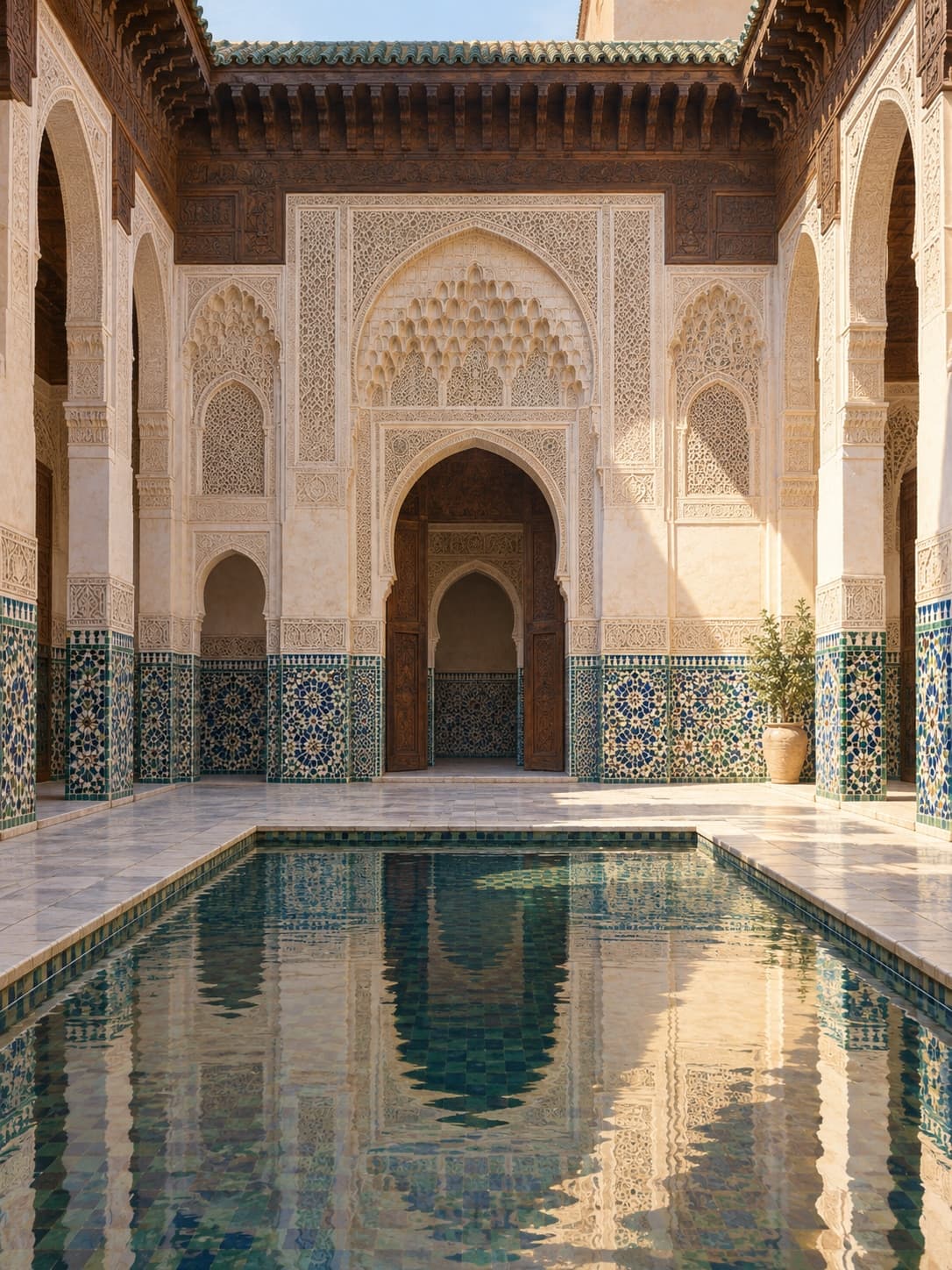
Zellij is mosaic tilework: glazed terracotta fired in flat colours, then cut by hand into small pieces — stars, kites, strips, the eight-pointed khatem — and set face-down into a drawing before the mortar is poured over the back. The pattern is not painted on; it is assembled from a few hundred shapes with names, and a master can lay out a sixteen-point rosette from memory. Fez has been its centre since at least the fourteenth century, when the Marinid sultans covered their madrasas with it.
In Marrakech the place to stand in front of it is the Ben Youssef Madrasa, rebuilt in 1565, where zellij runs to shoulder height around the whole courtyard before the stucco and cedar take over. The Bahia Palace floors are the other. On a wall, zellij art is flat, bold and unshaded — the studio’s Zellij collection paints it that way — and it suits a room that wants pattern rather than a picture.
2 · The Orientalists
Painters who came for the light and stayed for the doorways.
Eugène Delacroix travelled to Morocco in 1832 with a French diplomatic mission and filled notebooks with Tangier and Meknes; he painted from them for the rest of his life. Henri Matisse spent two winters in Tangier in 1912 and 1913 and came back with the blue-green pictures that changed his palette. Between and after them came a whole school of European painters — the Orientalists — for whom Morocco meant a particular light on a particular wall: the square at dusk, a souk in shafts of sun, ramparts at noon, a carved gate.
The tradition is the picture postcard’s ancestor and also much better than it. Its subjects are all still there: Jemaa el-Fnaa, Souk Semmarine, the pisé walls, Bab Agnaou. The Orientalist collection paints those four places in the manner of the nineteenth-century notebooks — not copies of any painting, but the same places at the same hours.
3 · The carpets
Four Atlas weaves you can tell apart across a room.
- Beni Ourain — undyed cream wool from the Middle Atlas, with a sparse lattice of black or brown lozenges. The one modernist architects fell for in the 1920s and 30s; still the most copied rug in the world.
- Azilal — from the High Atlas, on a cream ground but with colour: red, saffron, purple, a single-knot pile and asymmetric, improvised patterns.
- Boujad — from the plain below the Middle Atlas, and the warm one: pinks, oranges, madder reds, in loose diamonds and hooks.
- Boucherouite — the rag rug, woven from strips of recycled cloth when wool was short in the later twentieth century. Riotous colour, no two alike.
On a wall a carpet is a field of pattern with a hand in it, and the Carpets collection paints the four as fields — the winter blanket, the courtyard rug, the rosewater weave, the rag rug. The real ones hang in every rug merchant’s alcove in the souk, which the studio also paints at midday.
4 · The manuscripts
Maghrebi script, and a library older than any university.
The western Islamic world wrote in its own hand: Maghrebi script, rounder and more looping than the eastern styles, with long sweeping descenders and its own way of pointing letters. Qurans and treatises in it were illuminated with interlace, gold and lapis, and the Qarawiyyin in Fez — founded as a mosque and teaching institution in 859, its library established centuries later and among the oldest still working — holds some of the finest.
Manuscript art on a wall is ink, interlace and the geometry of a page: a study hand, a lantern-shaped frontispiece, a lending-room shelf. The Manuscripts collection paints those four in the manner of the fourteenth and fifteenth centuries. It is the quietest room in the collection and the one for a study or a hallway.
5 · The gardens
Water divided into four.
The Islamic garden is a plan before it is a planting: a walled rectangle, water channels dividing it into quarters, a basin at the crossing, fruit trees in the beds and shade over the paths. Marrakech has kept its great examples — the Menara basin dug around 1157, the Agdal orchards south of the Kasbah, and the riad plan repeated behind a thousand medina doors, of which Le Jardin Secret is the one rebuilt exactly. Then there is Majorelle’s, which is a painter’s garden rather than a sultan’s and is composed around one colour.
The Gardens collection paints the cobalt wall, the olive basin, a secret court and the Agdal orchards. It is the greenest room and the calmest.
6 · After Casablanca
The painters who hung their work in the square.
In the 1960s a group of artists teaching at the École des Beaux-Arts in Casablanca — Farid Belkahia, Mohamed Melehi, Mohamed Chabâa among them — set out to make a modern Moroccan art that owed nothing to the Orientalists and everything to the country’s own craft: the geometry of zellij, the signs on Berber carpets, worked copper and leather, the hard edges of the wave and the chevron. In 1969 they hung their paintings outdoors in Jemaa el-Fnaa, in the square, for anyone passing — a refusal of the gallery that is still the most famous exhibition in the country’s modern history.
The grammar they built — flat colour, repeated waves, signs, the materials of the workshop — is what the After Casablanca collection paints in: the terrace wave, flat fields, the sign, worked copper. On a wall it is the most contemporary of the six and the one that sits beside a modern interior without apology. It is also the tradition the new town belongs to, which is why the boulevard and the café terrace point to it.
Six traditions, one city. Every one of them is something you can still stand in front of.
Choosing
Which room for which wall.
- A room that wants pattern, not a picture: Zellij or the Carpets.
- A room that wants a view: the Orientalists or the Gardens.
- A study, a hall, a quiet corner: the Manuscripts.
- A modern interior: After Casablanca.
- Beside a portrait of your own animal: the Maâlem work of the same place — every place page names its adjoining room.
Each work is offered in three sizes with eight frame finishes, and a framed Maâlem or Collage print includes the snow-white mount rather than offering it as an extra. Availability is the honest part: a size is sold only when its source meets the studio’s 300 ppi standard, and at the time of writing none of the current masters does — every work page states its own position, and the prints page explains the rule.
See it on your own pet
Upload one clear photograph, choose a place, and look at the painting before anything is owed. First two previews free, no account or card; the full-resolution file is €15.
Try it on your own photo, free