Guide · Marrakech
Majorelle blue: the story of a colour
A painter from Nancy went to Morocco for his health and stayed for the light. The colour he left behind is the most photographed wall in Morocco.

The painter
A painter from Nancy, sent south for his health.
Jacques Majorelle was born in 1886 in Nancy, the son of Louis Majorelle, whose Art Nouveau furniture made the family name famous before Jacques had painted anything. He trained in Nancy and Paris, travelled to Egypt to paint, and in 1917 — in poor health and looking for a warmer climate — went to Morocco. He was meant to be passing through Marrakech. He stayed for the rest of his life.
What kept him was the light and the country beyond the city. Majorelle spent the 1920s travelling into the High Atlas to paint the kasbahs — the great earth fortresses of the mountain valleys — and the portfolio he published of them in 1930 is still the picture most people have of that architecture. He was, before anything else, a painter of ochre walls in hard sun.
The garden
Four hectares on the edge of the new town.
In 1923 he bought a plot on the edge of Guéliz, the French town then going up outside the medina walls, and began a garden around a house. He was a plantsman as much as a painter: over the following decades he brought in cacti, bamboo, palms, bougainvillea, water lilies and a great many species from elsewhere, planted around pools and channels in the Islamic manner, and kept adding to it. In 1931 he had the architect Paul Sinoir build him a studio in the cubist, art-deco style of the day — a sharp-edged modern block among the greenery, unlike anything else in the city.
The garden was expensive to keep, and in 1947 he opened it to paying visitors. It has been open ever since.
The blue
1937, and a colour that had to be seen through leaves.
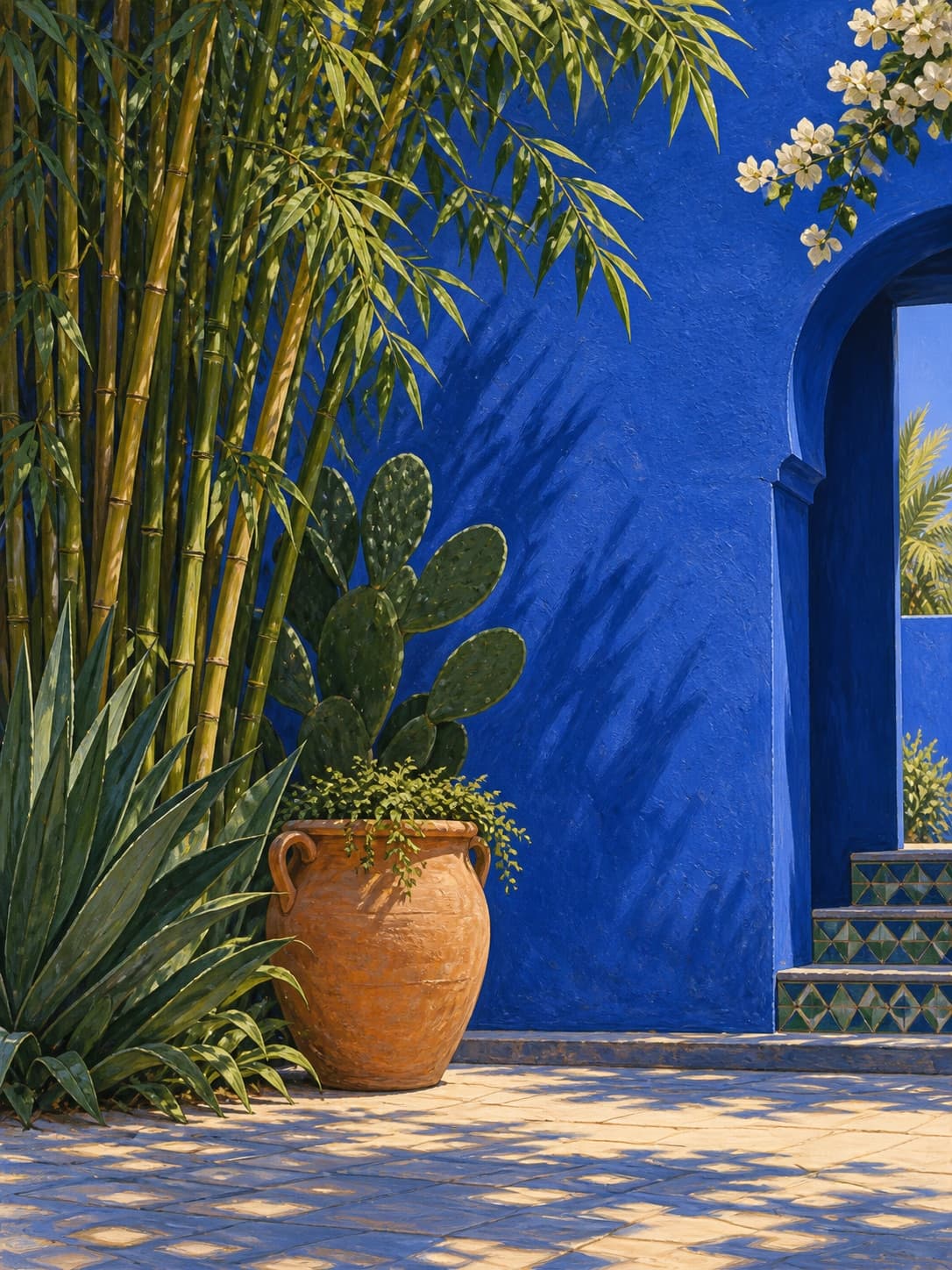
In 1937 Majorelle painted the studio, the walls, the pots and the pergolas an intense ultramarine — a blue with a little violet in it, saturated enough that bamboo and cactus read almost black against it. Where the colour came from is told several ways: the blue of a Berber burnous, the blue of the tiles he had seen in the south, the blue of French workmen’s overalls. What is certain is what he was doing with it. A painter who had spent twenty years on ochre knew that green is dull against ochre and electric against blue, and the whole garden is composed around that: the blue is a ground, and the planting is the picture.
The colour is now called Majorelle blue, and the story goes that he patented it. Whether or not a patent was ever granted, the name stuck, and the wall is the most photographed surface in Morocco.
Stand there at noon and the shade is blue rather than grey. That is the point of the colour.
Decline and rescue
Yves Saint Laurent, 1980.
Majorelle divorced in the 1950s, sold off parts of the property, was badly injured in a car accident, and died in Paris in 1962. The garden he left went slowly to ruin. By the late 1970s it was overgrown and there were plans to build a hotel on it.
Yves Saint Laurent and Pierre Bergé had been coming to Marrakech since 1966 and had walked in the garden for years. In 1980 they bought it, restored the planting, and kept it open. Saint Laurent said the garden’s colours were in his collections; after his death in 2008 his ashes were scattered in the rose garden of the Villa Oasis, the private house beside it, and a memorial column stands for him among the plants here. The studio became a museum of Berber culture, and in 2017 the Musée Yves Saint Laurent opened next door. It is now one of the most visited places in the country.
What the blue does to a portrait
The strongest colour contrast in the collection.
The studio paints the Majorelle wall in late morning, when the sun is high enough to light the cobalt without bleaching it: a studded green door, a yellow pot, the blue running from the ground up, and your pet on the ledge at the foot of the wall. There is no landscape and no distance. The colour is the setting.
Majorelle’s own logic applies. Cool coats — silver tabbies, grey and blue cats, black-and-white — sit inside the blue and glow. Warm coats do the opposite: an orange cat or a red dog against Majorelle blue is the most saturated picture the studio makes, which is why the demonstration cat wears a burnt-orange scarf. The one thing to avoid is a coat the same colour as the wall, and there are not many blue animals.
If you want the wall without a pet in it, The Cobalt Wall in the Maâlem collection is the studio’s painting of it — the wall and the planting, for what the colour does to green. Majorelle’s own canvases are another matter: he died in 1962 and his work is protected until 2033, so the studio paints the place, not the paintings.
Visiting
If you go.
The garden is on Rue Yves Saint Laurent in Guéliz, a short taxi ride from the medina. It opens early and the first hour is the quiet one; by mid-morning the paths are full. The blue photographs best with the sun on it and a leaf in front of it — the same rule the painter used. Then walk back through Guéliz for the jacarandas on the boulevard and a glass of mint tea on a café terrace, both of which the studio also paints.
See it on your own pet
Upload one clear photograph, choose a place, and look at the painting before anything is owed. First two previews free, no account or card; the full-resolution file is €15.
Try it on your own photo, free